Thanks to the virus-induced lockdown and both K and I working from home, M & m’s screen time has certainly gone up a lot. A silver lining has been some amusing moments.
Last week, I showed M&m a video of Kamala Harris, the democratic nominee for VP in the 2020 election. Her mom is from India and from Madras (Chennai), my own hometown. In the video which was a snapshot of various moments from Kamala’s life, there was one where she said “I stand for Medicare for all”. Without missing a beat, M asked me, “Do you know who is leading the fight for Medicare for all?” I said I do not know just so I can see what she says. And in all seriousness she said “Joe Kennedy is leading the fight for Medicare for all. I know it because he said so many times this week on TV.” I burst out laughing even as I was marvelling at her innocence and the power of repetitive TV ads.
Another ad that M&m love is for e-harmony. They have no idea what the ad is for (thank god!) but any time the ad comes on TV, they stop what they are doing because they like seeing young, healthy people endorse something on TV. Though m asked me what is harmony and so I am taking that as a vocabulary win.
TV ads were such a constant when we were kids and we hardly watched TV. The ones that immediately come to mind are Horlicks (kuddikka vendam, apdiyae saapiduven), Nirma (washing powder Nirma), Woodwards Gripe water (nee kuzhaindaya irukkarchae adai thaan kuduppen), Complan (Valarum paiyan ivan..), Boost (secret of my energy, our energy).
What comes to your mind when you think of TV ads???
I have been blessed to be born in a family where faith in god was a gift we received from the day we were born. And we we were surrounded by that in many forms – from the music of MS and Yesudas singing devotional songs that will melt your heart to the daily act of prayer which just happened everyday like we brushed our teeth and combed our hair. We also had the good fortune to have Santhananda Swamigal stay at our house for a few weeks each year. I loved when Swamigal stayed in our house. Not just because our house was milling with people bringing sweets and fruits (we were kids after all); but because I could just sit on the floor and listen to grown ups asking serious life questions to Swamigal and listen to him respond. Many many of those stories have been filed away in my brain but there is one sentence from those interactions that I remembered this week “Yad Bhavam Tad Bhavati” – “As you think so you become or you are what you believe”.
Source: nidtoons
The reason for this post are my kids. M has started reading (and m listens with great interest) Amar Chitra Katha books that have lots of religious stories. R and I loved those stories too. Last week they read Dashavatharam that narrates the story of the ten (dasha) avatars of Lord Vishnu. A sidebar is that the Dashavatharam story has many many similarities with Darwin’s theory of evolution. They also ask me to narrate the stories and one such story is about Prahaladha, a little boy who believes that Vishnu is everywhere, much to the chagrin of his father who is an Asura. His father goads Prahaladha and hits a wall saying ask your Vishnu to come and Vishnu appears as Narasimha (Half man and half lion) and vanquishes the father. This is a synopsis but hope you get the point. Of all the stories, this particular story is vivid in the kids’ imagination. Couple of days ago, I heard m tell the story of Narasimha and concluded that “God is whoever we believe God to be and is present wherever we believe God is”. QED. I heard her from the kitchen and thought about that simplistic sentence- isn’t that the essence of faith? If you believe, it is so.
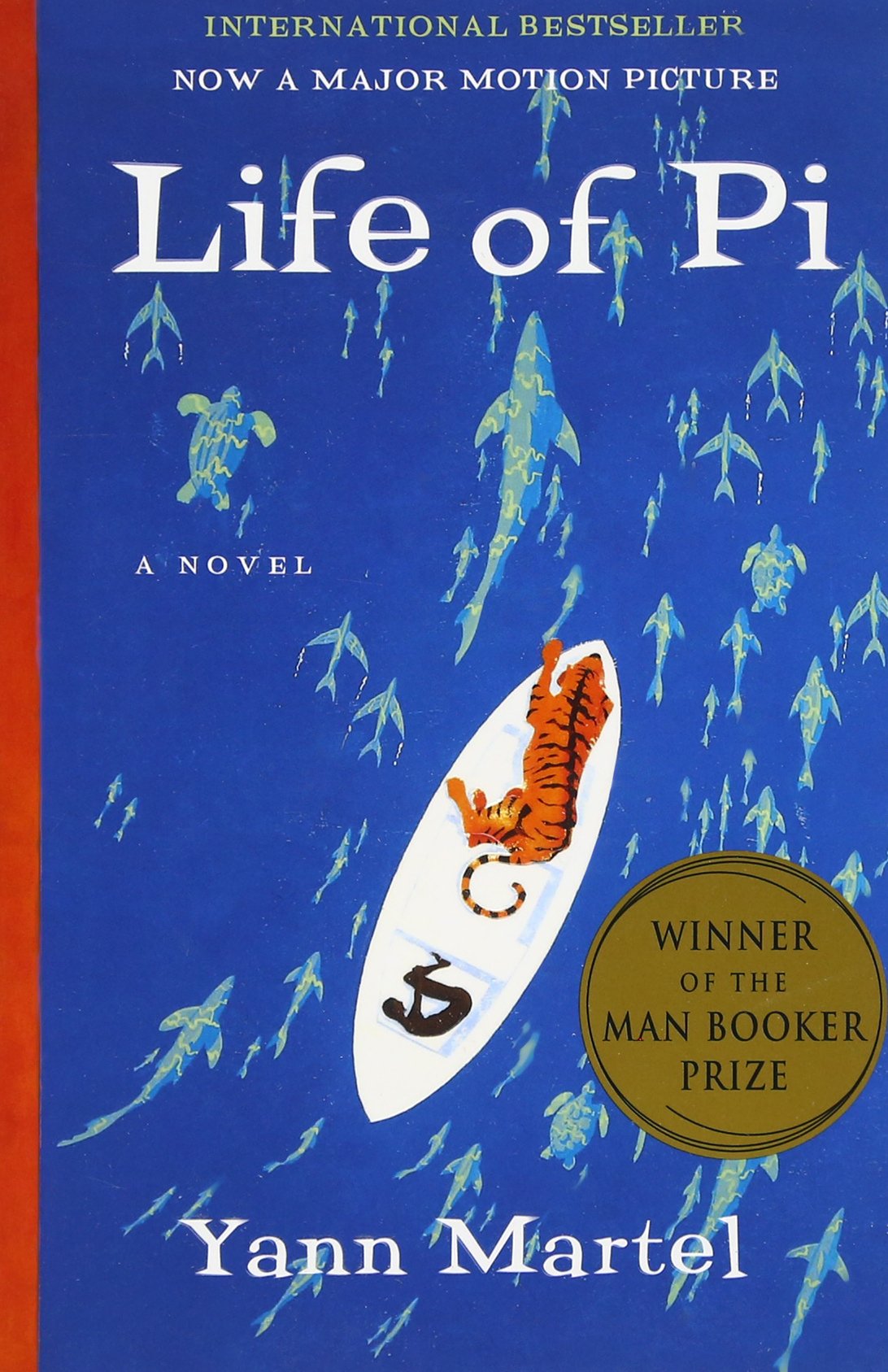
At this time, I would be remiss not to mention the book “Life of Pi” an amazing story that, to me, has always been about faith. Before I write about the book, let me say that my goal is not to convince people that God exists. I am equally accepting of atheists. Like me,
atheists have made a choice to believe in something, even if that belief declares God doesn’t exist. Back to Life of Pi – it is the story of a young man who survives a harrowing shipwreck and months in a lifeboat with a large Bengal tiger named Richard Parker. As he recounts the story, the officials do not believe his story about the tiger. He says “So tell me, since it makes no factual difference to you and you can’t prove the question either way, which story do you prefer?”. Well, I choose the story with Richard Parker, it is the better story.
Another wonderful quote – “I can well imagine an atheist’s last words: ‘White, white! L-L-Love! My God!‘—and the deathbed leap of faith. Whereas the agnostic, if he stays true to his reasonable self, if he stays beholden to dry, yeastless factuality, might try to explain the warm light bathing him by saying, ‘Possibly a f-f-failing oxygenation of the b-b-brain,’ and, to the very end, lack imagination and miss the better story.”.
Amma (mom) is extremely special for every one of us. This post is not to tell you why moms are special but to articulate how blessed I have been in my life to have my beloved Amma and Mami, a mother-like figure in my life. Parvathi Mami (Mami means aunt) has been in my life since I was born. To the outside world, she was our live-in cook but that word does not do her justice and is a real disrespect to her impact on our lives and the relationship we had over decades.
If Amma means unconditional love, Mami is certainly a second mother to me. She called me Ammu as a term of endearment. While my brother R was certainly her favorite, she loved us all unconditionally. Mami and I had our own bond – I used to hangout in the kitchen helping her with miscellaneous tasks (edupidi velai), ran to the market to get anything she needed last minute, served as the resident taster before food left the kitchen, and went for movies with her. Mami’s life was so busy when we were kids. She would get six lunch bags ready for the six kids by 8:30 am, I would help fill six water bottles, and check that spoons were in etc. I also remember helping her make sevai and she would always keep maavu (steamed rice flour) for me since I loved it. When I had congestion, she would force me to do aavi (steam) till I was sweating profusely and she was satisfied with the outcome. She used to make us a school day breakfast of paruppu saadam (lentil rice) with getti thayir (yogurt) with lots of ghee which still is my comfort food. I never like/liked to be babied by anybody but Mami was one exception – I never minded when she insisted on treating me like a kid since it made her happy.
Mami became a widow very early in her life and joined our family about five years before I was born. During the thousands of hours we spent in each other’s company, Mami reminisced with me about her formative years, her husband, and her family in Chidambaram. She lost her niece who she was very close to when the niece was in her late teens and she spoke about her to me. As a thirteen year old girl myself, I never knew what to say to make her feel better; but I realized that just listening to her seemed to be enough. I just hugged her hoping that the hug conveyed what I felt.
On the lighter side, Mami also invited me to be the judge in the mini skirmishes that happened with the other people that helped around the house -watchman, office people etc. She would ask me if the way she had reacted to a situation was right or not. And I did my best in being fair without hurting her feelings.
When my college friends visited me last year, they also remembered the amazing mixed rice (ellu saadham and thayir saadham) Mami packed for our two day train travel from Madras to Delhi. Not to mention the various rice powders (paruppu podi, thenga podi) and pickles Mami packed for me and my friends. She was Annapurni-incarnate (Hindu goddess of food and nourishment).
Mami was fiercely loyal to Amma and stood up to anyone who she felt slighted Amma. In this, we were so alike. When our joint family existence came to an end and our family moved away, Mami continued to stay with the nucleus of the joint family for a few months before she joined us. During those months, Mami often came to our school to see us and check in on us. My heart leapt when I saw her.
When Amma passed away, I know that her presence added a lot of stability to our household where Appa and R were alone. For that and all that Mami is/was to us, I am forever indebted to her. I have not been in close touch with her for over two decades since I moved to the US and daily life took over but think of her often. I believe that the bonds formed in those formative years holds strong even today when I think of her.
When she passed away almost a year ago, a piece of my childhood was forever gone. All I could hope was that she was reunited with her niece and is living happily in the other-world.
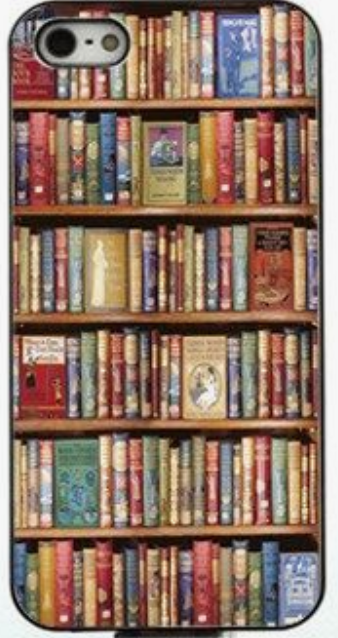
Books are my first love, a forever friend. It has always been this way for as long as I can remember. When in school and then college, I had the luxury of time. I could choose to stay up late to read a good book and sleep in the next morning. I could lose myself in the real or fictional characters, their lives and unique journeys, without a care in the world. My dream house always had a reading room with wall-to-wall wood paneled book shelves with neatly arranged books. It also had a reading corner with a cozy spot to sit and a warm blanket to truly get comfortable. A girl can dream right?
While my love for books never diminished, the time that I could allocate for that activity was greatly reduced with work, and more generally adulting activities. I went from reading a hundred books in a year to counting myself lucky if I could finish even five books in a year. I told myself that reading the TIME magazine counted but who was I kidding.
After we had kids, it became even more difficult to make time and kids became my number one priority. Between taking care of kids, work, household chores, driving to and from work and kids activities, sleep and exercise there was not that much free time left. And what little free time I had, I would rather spend with K and the kids than do anything else. So, reading books became a thing that I did in the past.
All this changed about two years ago. I now average about 30 books a year! My days did not magically have more hours though that would be awesome. I discovered Audible. I was initially resistant to the new modes of book consumption – kindle, audible etc. One of the reasons for my resistance was that I felt it was a betrayal to old school reading. But after trying it, I am now a true convert. Listening to a reader read a book does not equal the joy I get from holding a real book in my hand and reading it. That magic is special. But it is pretty good. And more importantly I am actually consuming a good number of books.
Source: Inicases.com
I can listen to Audible at any time – while picking up groceries, food prep, exercising, cleaning, driving..the opportunities are endless. I do have to rewind the audio sometimes if I was not paying attention and missed something but 90% of the time, I retain what I listen. And my phone is with me all the time which means I have all my books with me all the time and hence I call it untethered book consumption. It can hold more books than any wall to wall bookshelf I could have had. And I do not have to deal with heavy book boxes the next time we move!
And having books in my life again make me happy. Isn’t that one of the core things we pursue in life – happiness?
Freedom is usually defined as having the ability to act or change without constraint. But I think in real life, there is a more nuanced meaning for that word.
A few years ago, my friends and I were talking about career paths post graduation. A friend of mine said she is planning to be a stay-at-home-mom for a few years which prompted a lot of unsolicited but well-intentioned advise from the group on why she should not do it. After all, we have spent years (not to mention many thousands of dollars) on education with the unsaid goal of building a successful corporate career. Then, one person said that she cannot believe that someone in this day and age would even consider staying home; and that such decisions are a betrayal of the Feminism movement. That comment made me pause because the outcomes of the Feminism movement is not/should not be asking an entire generation of women to be beholden to a new set of rules and expectations i.e. one that says women should pursue careers; women should choose career over kids. Does that outlook not undermine the very basic tenet of the feminism movement?
I remembered that conversation this past weekend. I am reading (rather listening to) the book – The Water Dancer by Te-Nehisi Coates which traces the story of a young black man, Hi, who discovers that his memories trigger a mysterious power of teleportation that can help slaves escape to the North to be safe. In it there is a conversation between him and a character called Sophie, shown below:
“But freedom, true freedom, is a master too, you see—one more dogged, more constant, than any ragged slave-driver,’ she said. ‘What you must now accept is that all of us are bound to something. Some will bind themselves to property in man and all that comes forthwith. And others shall bind themselves to justice. All must name a master to serve. All must choose”
That line of thought encapsulates freedom to me. Freedom is not about being unshackled from anything and anyone. Freedom is about choice, your choice. Not society’s choice for you (also called norms), your family or friend’s choice for you (termed as expectations), but your choice – loud and clear. At the end of the day, we are all bound to something but we get to choose what and who we are bound to and how.
Do you agree with this more nuanced but simple meaning of freedom?
I am not talking about a marriage though that is worthy of another post given how our addiction to phones and apps prevents us from being present with the other person. This one’s about a patient-doctor relationship.
Source: fredericksburg.com; Dr. Steven Mussey
We all have probably visited a doctor and have noticed how much time the doctors seem to be spending on their electronic medical record system vs. having a real conversation with the patient. A study published in the Annals of Internal Medicine found that on average a physician spent 16 minutes and 14 seconds using the EHR (electronic health record) for each patient that he or she saw. And an average physician appointment is 15 minutes. Some parents have said that when kids draw their doctor, the ever present EMR always makes it into the picture. I am willing to wager that no doctor wants this but do it for many reasons including billing , documentation, liability etc. I cannot help but wonder if this is a case where the technology undermines the most important component of the interaction – a real dialog between the patient and the doctor? And do not even get me started on how difficult it is for me as a patient to get any of my records if I ever need it to get a second opinion or just keep it for reference (another post for another day).
Growing up in India, we had a family PCP – Dr. KV in Ashok Nagar. When any of us got sick such as a cold, fever etc, we went to the doctor’s office which was an independent practice. KV’s office was an examination room and a small waiting room with a long wooden bench. When we arrived there, a peon (office boy) gave us a ticket with a number and we sat on the bench to have our number called out. No preferential treatment for anyone, no appointments – you showed up, got the ticket, and waited your turn in the line till the peon called out your number. Each person gave their ticket back to the peon on their way out.
When you walked in, the doctor’s office had the bare minimum essentials. KV’s desk with two chairs and an examination table, and a sink to wash hands. No electronic medical records, no nurse hovering over you to take your temperature before the doctor sees you etc. KV looked at you, asked about your symptoms and did the examination, made a diagnosis, wrote a script (if that was the best action), or asked you to go for a lab test (if required). Majority of the patients walked out with a script (no e-script sent to the pharmacy). KV always asked if you had any questions, told how soon you should see relief etc. As a patient, you never felt hurried. As a patient, you felt you had 100% of KV’s attention. As a patient, the eye contact mattered and conveyed empathy. As a patient, you felt more confident that you will get better. He was an amazing diagnostician and it was bedside manner at its best. He never asked to hoard your blood test, x-rays etc. He saw it and gave it back to you for safe keeping. And the payment was cash and direct to Dr. KV and pretty nominal (120 rupees or $2 in today’s terms). He certainly did not have the office overhead with systems, backups, billing staff, mailing bills, insurance hassles etc.
On slow days, when I walked in, I saw KV reading an English novel but he immediately stashed it into the table draw when I walked in. He had an amazing memory and would inquire about my grandfather’s health, or family. I am sure there were instances where KV had to refer a patient to a major hospital or a specialist but a majority were run of the mill cases that needed immediate care and expert advise.
When I came to the US, I realized that immediate care meant ER since most doctors could not fit you in to their schedule. At least these days there is a proliferation of urgent care making the cost to the system better but I would not call it fast or easy for that matter. In my experience, a trip to urgent care takes a couple of hours at least. For the ER, it is closer to 6-8 hours.
Why does access to convenient low-cost but good healthcare with an amazing primary care doctor have to be this hard in a developed country such as US? I have thought about Dr. KV more than a hundred times any time I ponder this question.
When we were kids, R and I were often asked if we were twins because we are pretty close in age, hung out a lot together, and always looked out for each other via some sixth sense. I think the last part still holds though we do not hang out anywhere near enough (a few oceans separate us physically) and it has been a while since anyone asked if we were twins.
As kids, R and I spent hours riding our bikes in the Ashok Nagar / KK Nagar area and had many an adventure. Manthoppu colony, Postal colony, Ayodhya mandapam, ESI, Pillar, MGRnagar – you name the street in that area and we have ridden our bikes there. There is a saying in Tamil – “Kamban ( a great Tamil poet) veetu kattu thariyum kavi paadum“, meaning “Even Kamban’s loom can pen a poem”. Like that, even the roads of Ashok nagar and KK nagar will sing our stories since our childhood was a blast.
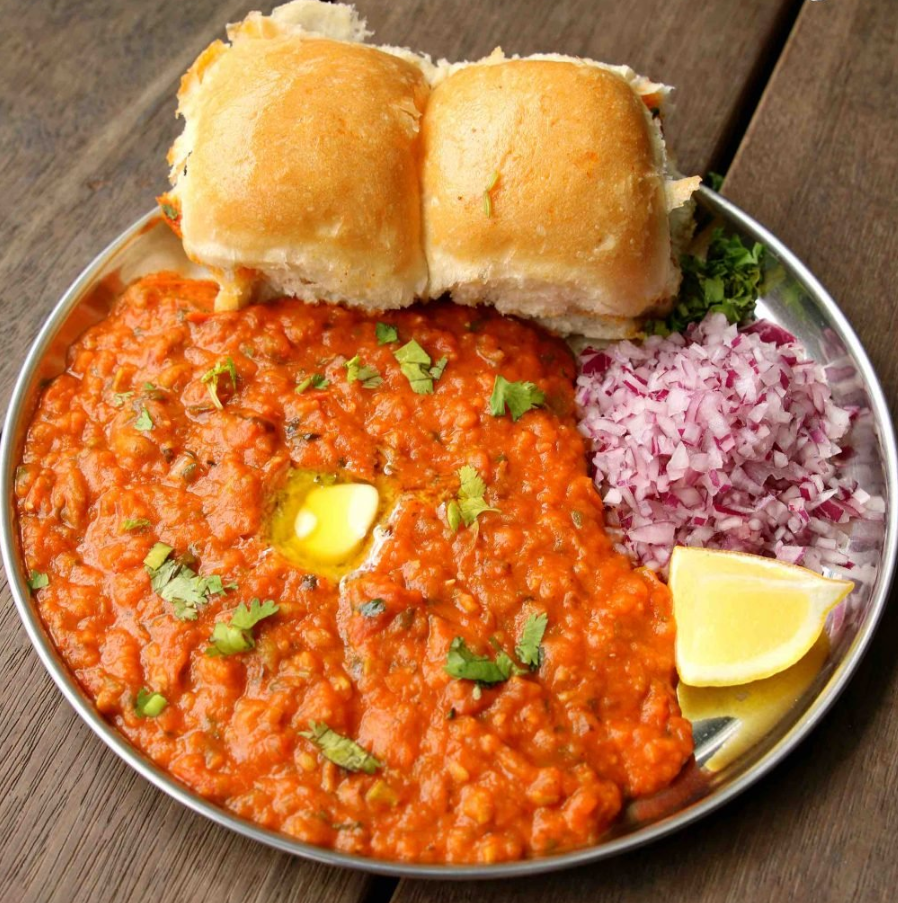
One of the places we frequented was Matta Fast food. It was a small shop that opened in Ashok nagar by Manthoppu colony in the mid 1980s. They served mainly North Indian dishes like Pav Bhaji which is not something we cooked at our South Indian household typically. To R and I, this was fancy. R and I were early patrons – some times we would stop by on the way back home from school; other times, we came home, changed our clothes, biked for some time and found our way there. Matta was not a sit down restaurant. It was literally one room in those days for cooking with a bench to sit on outside.
R and I would bike there, yell out our order, and wait for it to come while doing small talk with the shop owner. We could also see the food being cooked. They had this huge circular tawa where the bhaji would be cooked non-stop and the pav would be cooked in butter as orders arrived. It is a fascinating thing to watch these things being cooked.
Source: Hebbar’s kitchen
When the plates arrived with raw diced onions and lemon on the side, we would hold it in our hand (kai in tamil) and dig in. Having Gobi 65, Pav bhaji and Bread channa with steam coming from the plate was too much of a treat for us. The pav was toasted with butter and was so good just by itself. And there was a dollop of amul butter on the bhaji.
While I do not remember how much we paid, it was not more than ten rupees for a delightful repast for two little kids with voracious appetites. Things like hygiene and calories was not even a thought in our mind. All that mattered was the delicious food. R was such a master that he would gobble his order super fast and look at me with puppy dog eyes and ask me to share with him. I would relent grudgingly…
Many five star restaurants cannot even come close to the taste of street food from Matta. I do not know if Matta would make it to the late Anthony Bourdain’s Parts Unknown, but it will make it to my list of the best street food that I have had:)
I love Madras. Having grown up there and thanks to my bicycle, Kinetic Honda, and good friends, I have traveled to every nook and cranny in Madras.
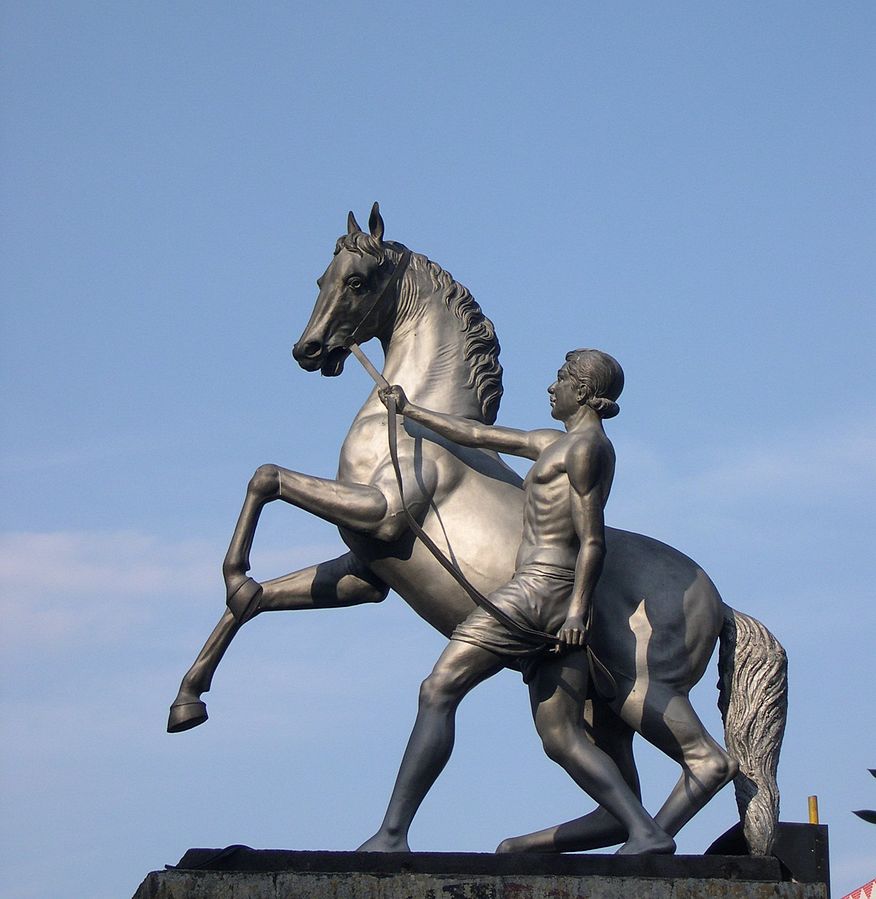
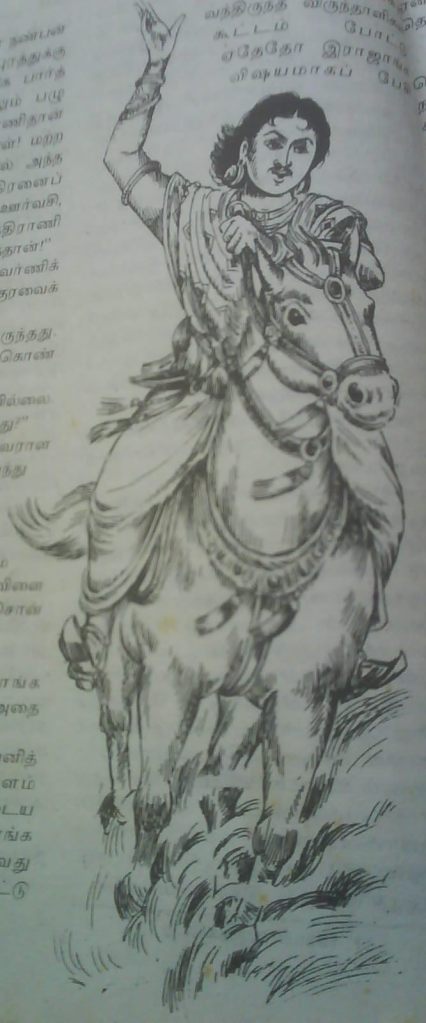
When you think of Madras, one iconic place that comes to mind is the Gemini Flyover. Gemini flyover was built in 1973 and was so called since the lauded Gemini studios used to be there but has since been demolished. One of the landmark statues of Madras is the pair of equestrian statues at the Gemini circle. The statues are meant to celebrate abolition of horse racing and some say the statue was inspired by Vandhiya Thevan from Ponniyin Selvan (Kalki’s epic historical novel). Even though I have driven by the statues and on the flyover thousands of times, I still get a little thrill every time I see it – the statue is impressive if you pause to look at it.
Close to the flyover are many many memories. On the side of Nungambakkam high road with Palimar (looking at you R for giving them a run for their buffet), Landmark book shop which was a hip spot once upon a time, Rani Seethai Hall (so many plays that I have seen with friends); Towards Mt. Road is Safire theater complex with so many Malayalam hit movies (remember High Highness Abdullah and Vandanam) and Spencers (the old regal one!!); and my favorite side is by far the Cathedral road side with Drive-in, US Consulate, Mowbrays Road, Music Academy, and Woodlands (where I got married) – this is the side I call Amma’s side of the city. Amma was at her heart a Mylapore lady and her love spread to me. It is the same side (further down) that had Canopy (remember Romali roti show), Isabel hospital, Rangachari, TNSC Bank Anjaneyar, and ofcourse Luz, Kulam, and Kapaleeshwar koil.
Ahhh..Woodland Drive-in. For many many years, it was a green haven amidst the city with a restaurant tucked away inside. PBS, the yesteryear singer, was a common sighting at Drive-in. Their delicacy was hot Basundhi around 3 pm – they often ran out and so you had to be there at the right time to get it. And who can forget the orange slushy on a hot summer day. In those days, going to restaurants was a rare occurrence for everyone, including us. For us kids, it was a real treat to go to Drive-in and stay in the car and eat.
The restaurant has been closed since Woodland’s lease ran out but I thank that place for so many fond memories as a child and young adult…
Growing up, I was the youngest kid in my house. So, I tagged along with Amma (mom) all the time. Amma was an amazing woman with many gifts and storytelling was one such gift. Guess it ran in her family since her father (NSM) was an amazing storyteller. This post is about one such deeply personal story – simple in its contents but deep in meaning to me. And one that I often recall…
In the 1910-1920s, there was a boy named Mani who grew up in a village in India and his family struggled to make ends meet.The boy was a bright young man who walked daily from his village to the next village to attend school. When it was time to attend college, he left his village and moved to a city for college.
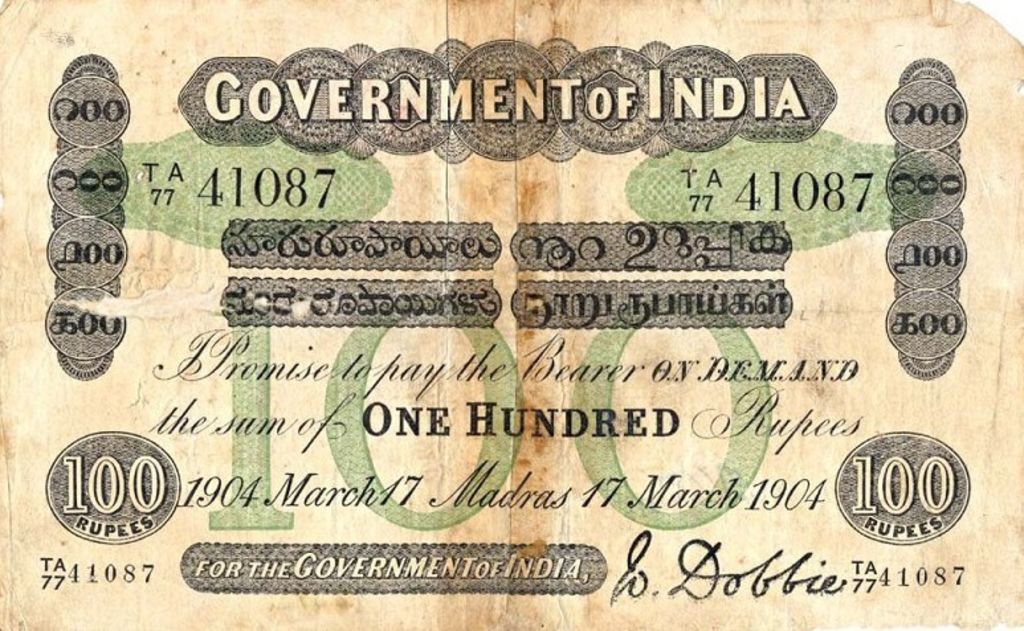
After graduation, Mani landed a job in a college teaching English. He received his paycheck and saved as much as he could. When he saved 100 rupees (Google tells me that is about 5,000 indian rupees in today’s value), he withdrew it from the bank as one hundred rupee note and boarded a train headed for his village.
Source: Banknote Index
Mani’s father had never seen a hundred rupee note in his life and the boy wanted to surprise his dad with it. He wanted his father to be reassured that his family was going to have better times ahead. Mani could not sleep that night since he wanted to see his father’s reaction to his surprise visit and the hundred rupee note.
When the train pulled into his village station, many people from his village were standing in the station pavement. Mani got down and the villagers rushed to him asking “Mania, yaaru sonna (who told you?); eppidi therinjudhu (how did you know?)?”. Mani was confused and it took him some time to understand that his father had passed away the night before. The villagers, including some of his family members were at the station wondering how to send this news to Mani and have him come right away. They could not fathom how Mani made it to the village that morning. Mani just fell to the ground and was crushed.
The first time my mom told me this story, I cried. Even today, when I tell this story to someone, I tear up. Putting myself in the shoes of Mani, I was anguished and angry. The one thing a parent wants is to see his/her children happy and doing even better than they did; in the same token, (many) children want to meet or exceed their parent’s expectations in every way. Angry and sad that his father could not see that Mani was doing well in life seemed very unfair.
That Mani was NS Mani, my maternal grandfather. We called him Amma Thatha which literally translated to Maternal Grandfather since Amma means Mom and Thatha means Grandfather. Amma Thatha went on to become a much lauded English professor, opened his own college in Madras (I refuse to call it Chennai) and made boatloads of money and a name for himself. He was friends with presidents of India (R. Venkataraman, VV Giri, and Radhakrishnan) and the social elite in Madras in the 1960s and 1970s were frequent guests at this house. Despite all that, the pain of that incident was still fresh in his mind/heart even in his 80s..sometimes life is not fair but it teaches us that the best of highs and the worst of lows are much better spent with our loved ones close to us always. That is the true treasure – cherish it when you have it!
With Covid, there is a lot of talk about social isolation in the US and how it can lead to or is leading to many mental health issues. But let us take a step back and think about seniors aka people over 65. According to US census data, 1 in 3 seniors live alone. These seniors are isolated whether there is Covid or not. That is not to say that they do not see or interact with someone during the day but I am willing to bet they are typically not high quality interactions. Now, that made me think of my childhood…let us take a walk down my memory lane.
As a child growing up in India, we lived in a “joint family” where I lived with 5 other kids (2 siblings and 3 cousins), my parents, my uncle and aunt, my grandfather, one live-in cook (more like a family to us) – that is about 11 people. It does not stop there. My dad and uncle ran a business and so we had an attached office which had about 5 full time employees and many many people coming and going everyday. I can only imagine how lucky my grandfather was to have so many of his family so close by. If anything, he probably wanted some privacy now and then.
He would hang out with us when we played in the yard, be the umpire during our cricket games, teach us yoga, urge us to do daredevil stunts (resulting in a skinned knee every now and then), and regaled us with stories about the olden days. My dad and uncle would always spend time speaking with him about any topic he wanted in the evening. My mom and aunt took care of him as their own making sure everything was done to his liking.
There was never a day when we was bored, alone, or felt unwanted. To add to this, his daughter (my aunt) visited often, many of our relatives visited us and spent hours speaking with him. And everyday when I came back from school in the evening, I would see a circle of my granddad’s friends having coffee and snacks and chatting. My grandfather was in his element during these visits and was the star of the show. He lived a full life.
Which brings me to a question I have been mulling over in my head…what is the solution to the social isolation problem for seniors? How can we ensure that they feel wanted and have high quality interactions? I am not saying everyone should live in a joint family which has its own pros and cons. What do you think?



 epiphanu